The Return of Ancestral Gods by Mariya Lesiv
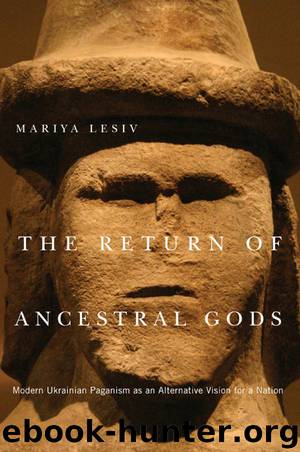
Author:Mariya Lesiv
Language: eng
Format: epub
Publisher: MQUP
Published: 2013-07-13T16:00:00+00:00
For Pagans, these lyrics express a sense of pride in belonging to both the present-day Ukrainian nation and to the unique community of the old Slavs.5 Together, both are imagined as an organic whole. Benedict Anderson (1991, 6) aptly points out that a national community “is imagined because the members of even the smallest nation will never know most of their fellow-members, meet them, or even hear of them, yet in the minds of each lives the image of their communion.” In the case of Ukrainian Pagans, this imagination expands not only to the fellow members of the contemporary Ukrainian national community and to those who are within people’s historical memory but also to those who lived on the territory of present-day Ukraine in “prehistoric” times and of whom very little is known.
For Ukrainian Pagans the imagined achievements of their imagined ancestors form the core of the unique Ukrainian nation ( “Well, where else is there such a people?”). Their vision of Ukraine is connected with its native religion, the roots of which were “buried” but are now being rediscovered. Collective ritual singing allows Pagans to glorify their ancestors and themselves as their descendants – as what Anthony Smith (1996, 586) would call “chosen people,” an ethnic community “entrusted with a sacred mission to proselytize or crusade or act as standard-bearer of the true faith.”
Consolidating Beliefs
Belonging to the same group does not necessarily imply consistency in the beliefs of the groups’ members, “not only because the different participants have different beliefs, but also because each of the participants has a formless morass of conflicting beliefs” (Kertzer 1991, 90). Participants often reach consistency through common actions.
Numerous creative interpretations of the past result in a certain amount of inconsistency in Ukrainian Pagan beliefs. Rituals help each group consolidate its views. For example, unlike other Pagans, Ancestral Fire followers emphasize the importance of their life-long allegiance to the spiritual leader Volodymyr Kurovskyi, who strives to maintain centralized power and stresses that whoever performs the ritual of name-giving (usually either Kurovskyi himself or one of his closest followers) becomes a “spiritual father” to new Pagans for the rest of their lives. Furthermore, as a result of Kurovskyi’s workshops and interactive lectures on the topic of Rodolad (order in family), many Ancestral Fire followers speculate about family and social relationships in terms of compatible or incompatible psychological types. Rodolad differentiates Ancestral Fire from both Native Faith and RUNVira as the doctrines of the latter two do not embrace psychological theories.
Constructing Memories
While paying homage to Shevchenko on Ukraine’s Independence Day in 2006, the leader of Ancestral Fire, Volodymyr Kurovskyi, said: “Let us perform the holy ritual of unification with our Ancestors! We have a powerful spiritual leader of our family, Taras Shevchenko, who glorifies our family with his spirit, his holiness and his wisdom, and who teaches our family! We know that wisdom is rooted in Veles, and thus the power of Veles talks to us through Taras’s words! Thus, let the spirit of Veles be
Download
This site does not store any files on its server. We only index and link to content provided by other sites. Please contact the content providers to delete copyright contents if any and email us, we'll remove relevant links or contents immediately.
The Vikings: Conquering England, France, and Ireland by Wernick Robert(84604)
Ali Pasha, Lion of Ioannina by Eugenia Russell & Eugenia Russell(40384)
The Conquerors (The Winning of America Series Book 3) by Eckert Allan W(39136)
The Vikings: Discoverers of a New World by Wernick Robert(37049)
Cecilia; Or, Memoirs of an Heiress — Volume 1 by Fanny Burney(32726)
Cecilia; Or, Memoirs of an Heiress — Volume 2 by Fanny Burney(32090)
Cecilia; Or, Memoirs of an Heiress — Volume 3 by Fanny Burney(32068)
Empire of the Sikhs by Patwant Singh(23207)
The Secret History by Donna Tartt(19475)
Hans Sturm: A Soldier's Odyssey on the Eastern Front by Gordon Williamson(18726)
Cat's cradle by Kurt Vonnegut(15558)
Pimp by Iceberg Slim(14804)
Sapiens: A Brief History of Humankind by Yuval Noah Harari(14557)
Norse Mythology by Gaiman Neil(13575)
Talking to Strangers by Malcolm Gladwell(13556)
Leonardo da Vinci by Walter Isaacson(13522)
4 3 2 1: A Novel by Paul Auster(12626)
Underground: A Human History of the Worlds Beneath Our Feet by Will Hunt(12236)
The Radium Girls by Kate Moore(12186)
